People analytics & culture
Why your culture survey score doesn't predict what's coming next.
Engagement is 7.2 out of 10. The pulse survey looks stable. Three months later, four people from your strongest team hand in their notice. The survey gave you no warning — not because it was badly designed, but because it cannot detect what employees feel. It can only detect what they write.
Published April 2026 · By Jonathan Prescott, Cavefish · Part of the EchoDepth Insights series
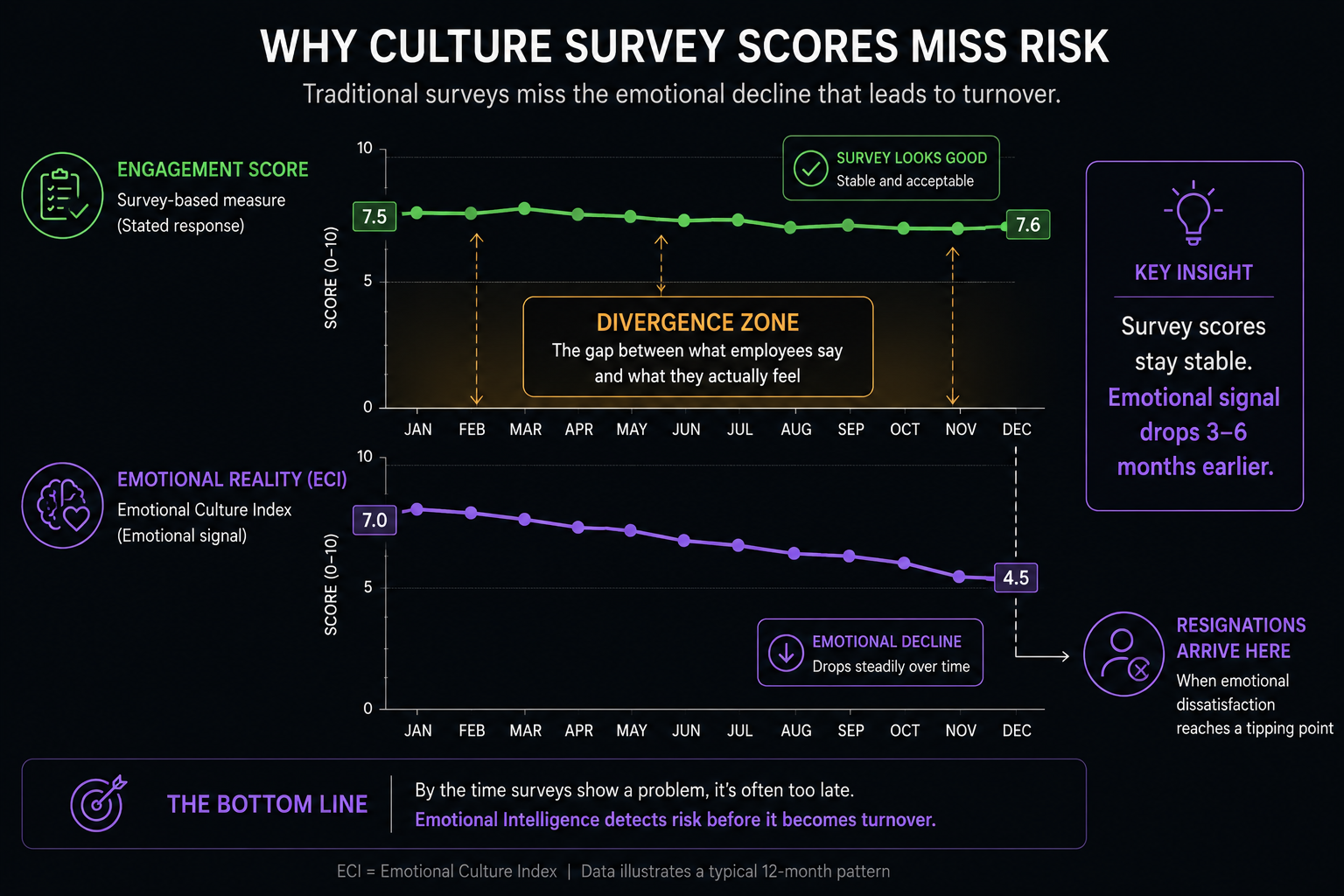
The mechanism: why employees write neutrally when they feel negatively
This is not a problem with your survey design, your questions, your platform, or your anonymity guarantees. It is a problem with the fundamental act of asking employees to describe how they feel in a professional context where their responses exist on organisational record.
Employees experiencing early disengagement — the first stage before quiet quitting becomes visible, before the decision to leave has crystallised — do not write strongly negative survey responses. They write neutrally. They produce professionally managed, non-committal language that describes their workplace experience in terms that neither trigger management concern nor register as dishonest.
They do this because they are socially intelligent. Even with anonymity guarantees, survey responses live in an organisational system. Employees know this. They have watched colleagues be identified from "anonymous" responses. They have seen managers respond badly to negative feedback attributed to their team. The rational choice, for an employee who is emotionally withdrawing but has not yet decided to leave, is to write carefully.
The result is masked dissatisfaction: a systematic underrepresentation of genuine negative emotional experience across every survey-based engagement platform, regardless of how well-designed the survey is.
What masked dissatisfaction looks like
Here is what the pattern looks like in practice. An employee who has been passed over for promotion, who is watching a peer receive credit for their work, or who has lost confidence in their manager's direction will write something like:
Read that response. It is not dishonest. Every sentence can be defended. And it will score as positive-neutral in any NLP sentiment analysis — in Culture Amp, Glint, Qualtrics, or any other platform that analyses the words people choose to write.
What the words do not show: the emotion that produced them. Anxiety. Resentment. Disconnection. A sense of being undervalued that the employee has decided is not safe to express directly. The written response and the felt experience diverge significantly — and that divergence is exactly what an HR analytics platform operating on text alone cannot detect.
The pre-exit emotional pattern
What emotional AI detects in the months before a resignation is not a sudden negative response. It is a gradual shift in the emotional signal beneath the written response — while the surface language remains carefully neutral or mildly positive.
In EchoDepth's scoring framework, the key signal is the negative-to-positive valence ratio. In a well-functioning team, this ratio sits below 1.2:1 — the emotional language, even accounting for masked dissatisfaction, produces slightly more positive than negative affect. As an employee moves through disengagement toward exit, this ratio shifts:
Below 1.2:1
Healthy — normal range
1.2:1 – 1.5:1
Structural friction — investigate
Above 1.5:1
Systemic strain — turnover risk
A ratio above 1.8:1 — what EchoDepth calls the pre-exit condition — represents a workforce that is functionally performing but emotionally exhausted. People scoring above this threshold typically resign within 12 months. The survey scores remain stable. The emotional signal has been warning for months.
Text-emotion divergence: the gap surveys cannot see
The specific signal that EchoDepth measures is text-emotion divergence: the difference between the sentiment of the written response and the emotional state that produced it. When these two things align — when an employee who feels positive writes positively — divergence is low. When they misalign — when an employee who feels negative writes neutrally — divergence is high.
High divergence is not a sign of dishonesty. It is a sign of professional self-protection in an organisational context. And it is the most reliable early indicator of masked dissatisfaction available from any data source.
The critical point for HR analytics: you do not need new surveys, new questions, or new platforms to access this signal. EchoDepth applies the emotional AI analysis to the open-text responses from your existing Culture Amp, Glint, Peakon or Qualtrics surveys. You export the anonymised text. EchoDepth scores it. You receive the divergence analysis — which teams, which themes, and which survey items are showing the largest gap between stated and felt experience — within five working days.
What an employee feedback tool can and cannot do
Culture survey platforms — Culture Amp, Glint, Peakon, Qualtrics Employee XM — are excellent at what they do: collecting structured and unstructured feedback at scale, benchmarking against industry norms, providing managers with team-level dashboards, and tracking stated engagement trends over time. None of this is replaced by emotional AI.
What these platforms cannot do — structurally, regardless of how sophisticated their analytics are — is measure the emotional state that produced the written response. Their NLP and sentiment analysis layers score the words. The words are what employees chose to write, not what they felt. The gap between the two is where retention risk lives.
HR analytics that combines both layers — stated sentiment from your existing survey platform and felt sentiment from emotional AI analysis — produces early warning capability that neither layer alone can provide. The survey tells you what people said. The emotional AI tells you what they felt. The discrepancy between the two is where the board conversation should start.
Common questions
Why does my culture survey not predict employee turnover?
Related
Culture analytics & people analytics platform
How EchoDepth adds emotional intelligence to existing culture survey data — from data to information to knowledge the board can act on.
Related
EchoDepth vs Culture Amp
A detailed comparison of what Culture Amp and EchoDepth each measure — and how they work together for early retention warning.
Methodology
How to measure employee sentiment accurately
Why traditional sentiment surveys underestimate negative affect — and what the ECI framework measures instead.
EchoDepth Insight
Find out what your culture survey is not telling you.
Send us your most recent survey open-text export. We will show you what the emotional AI layer detects — including whether masked dissatisfaction is present and where it sits.