Culture survey vs emotional AI — what is the difference, and why does it matter?
Culture surveys have been the primary tool for measuring employee experience for three decades. Emotional AI does not replace them — it reveals what they cannot measure. Here is what that gap looks like in practice.
Published April 2026 · Part of the EchoDepth Insights series · By Jonathan Prescott · Cavefish · 8 April 2026
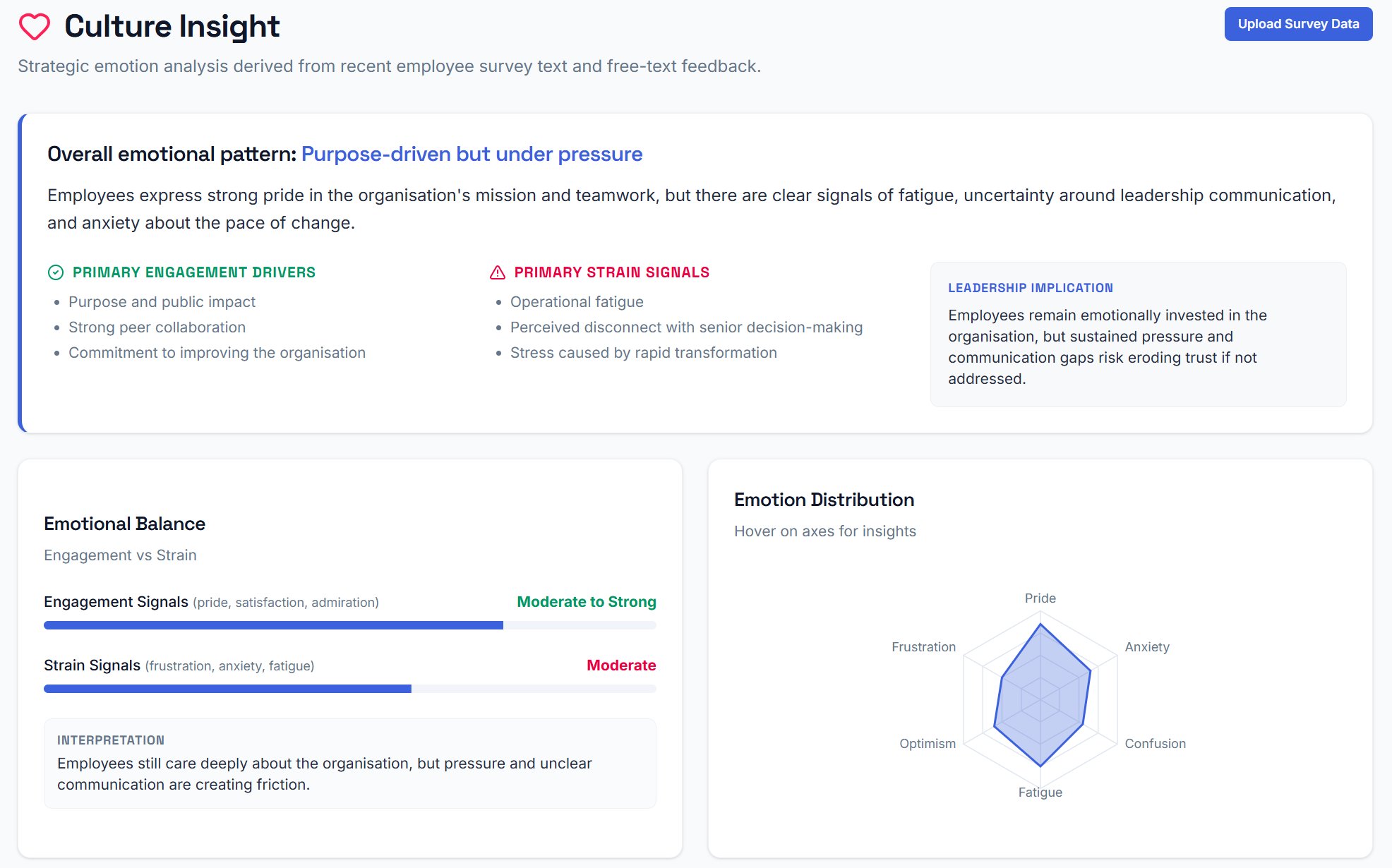
What a culture survey actually measures
A culture survey measures what employees are willing to say, in the language they choose to use, moderated by their assessment of how the response will be received. That is not nothing — it captures stated attitudes, explicit preferences, and self-assessed experience. But it is subject to three forces that systematically distort the data.
The first is social desirability bias. Employees know — even in anonymised surveys — that responses about leadership, management style, or organisational dysfunction carry professional risk. The result is language that is accurate in direction but suppressed in intensity. An employee who scores their manager a 6 out of 10 may be experiencing what they would describe privately as a 3.
The second is the articulation gap. People and culture professionals know this intuitively: when you ask employees to describe how they feel about a change programme, you get descriptions of what they think about the change, not what they feel about it. Emotion and cognition are processed differently in the brain, and the verbal channel reliably produces the cognitive output while the emotional experience stays below the surface.
The third is the professional filter — the real-time moderation that happens as someone writes a survey response. They are not simply reporting experience; they are composing a professional communication that balances honesty, safety, and the implicit audience of whoever will read it.
What emotional AI adds
Emotional AI — specifically the text-emotion analysis layer that EchoDepth applies to culture survey responses — does not bypass these forces entirely. But it makes them visible. The core output is text-emotion divergence: the measurable gap between the written content of a response and its emotional signature across 53 dimensions.
When a people and culture leader reads a survey response that says "I think we could communicate change more effectively as an organisation," they see a measured, constructive comment. EchoDepth scores the same response: Disappointment 0.31, Doubt 0.28, Contemplation 0.19, Annoyance 0.14. The written content is moderate. The emotional signature is not.
This divergence — between what employees say and what they feel — is the most operationally significant signal in people and culture measurement. It is also the one that no survey platform operating on text alone can detect.
The masked dissatisfaction problem
EchoDepth refers to high text-emotion divergence as masked dissatisfaction: the condition where an employee's expressed concern is worded diplomatically but the underlying emotional data shows significantly elevated negative affect. Disapproval, Contempt, and Distress co-occurring beneath a professionally phrased response is a different risk profile than overt negative feedback.
Overt negative feedback — "the management here is terrible" — tells you there is a problem. It also tells you the employee is still emotionally engaged enough to complain. Masked dissatisfaction tells you something more concerning: that the employee has already concluded that expressing what they actually feel is professionally unsafe. That conclusion is the pre-exit state. It precedes disengagement, quiet quitting, and eventual departure by months.
For people and culture leaders, the implication is specific. When the Trust Risk Register shows that employees write positively about work-life balance in surveys while the emotional scoring shows Distress and low Dominance on the same theme, the gap is not a data anomaly — it is a signal that the employer brand promise around flexibility is not being experienced as genuine.
What a 1.8× valence ratio means
The headline metric EchoDepth produces from a culture survey dataset is the negative-to-positive emotional valence ratio: the average intensity of negative emotional states (Disapproval, Annoyance, Disappointment, Contempt, Distress) compared to positive states (Admiration, Love, Pride, Satisfaction) across all responses.
In a well-functioning organisation, this ratio typically sits below 1.2:1. Ratios between 1.2:1 and 1.5:1 indicate structural friction — addressable with targeted intervention. Above 1.5:1 indicates systemic strain, with elevated voluntary turnover risk within 12 months.
A ratio of 1.8:1 or above represents the pre-exit condition: a workforce that is functionally performing but emotionally depleted. The survey scores at this point are often still moderate — because masked dissatisfaction is doing exactly what it describes. The emotional data tells the story the text cannot.
The practical workflow
The most important thing to understand about emotional AI in people and culture measurement is that it is additive, not disruptive. EchoDepth does not require a new survey methodology, different questions, or a change to the tools your organisation already uses. You run your culture survey as normal. You upload the open-text responses. EchoDepth applies the additional scoring layer and returns a Culture Health Report structured for board presentation — covering the emotional valence by theme, the risk register with severity ratings and verbatim evidence, the strengths worth protecting, and a 180-day action programme.
The survey platform continues to produce its engagement scores and benchmark comparisons. EchoDepth adds the emotional AI layer that changes what those scores mean — and surfaces the signals underneath them that the scores alone would never show.
The bottom line for people and culture leaders
Your culture survey is not wrong. It is measuring the right thing — employee experience — with the wrong instrument for the emotional layer. Emotional AI does not replace the survey; it makes the survey produce a different class of result. The question is not whether the gap between stated and felt experience exists in your organisation. It does. The question is whether you have visibility of it before it becomes a retention crisis.