HR analytics & people analytics
What is people analytics — and where does it fall short of predicting what matters?
People analytics has transformed how organisations understand their workforce. It measures what employees do, what they say they think, and how those patterns correlate with outcomes. What it cannot measure is what employees actually feel — the emotional signal beneath every survey response that drives the decisions people analytics tries to predict.
Published April 2026 · By Jonathan Prescott, Cavefish · Part of the EchoDepth Insights series
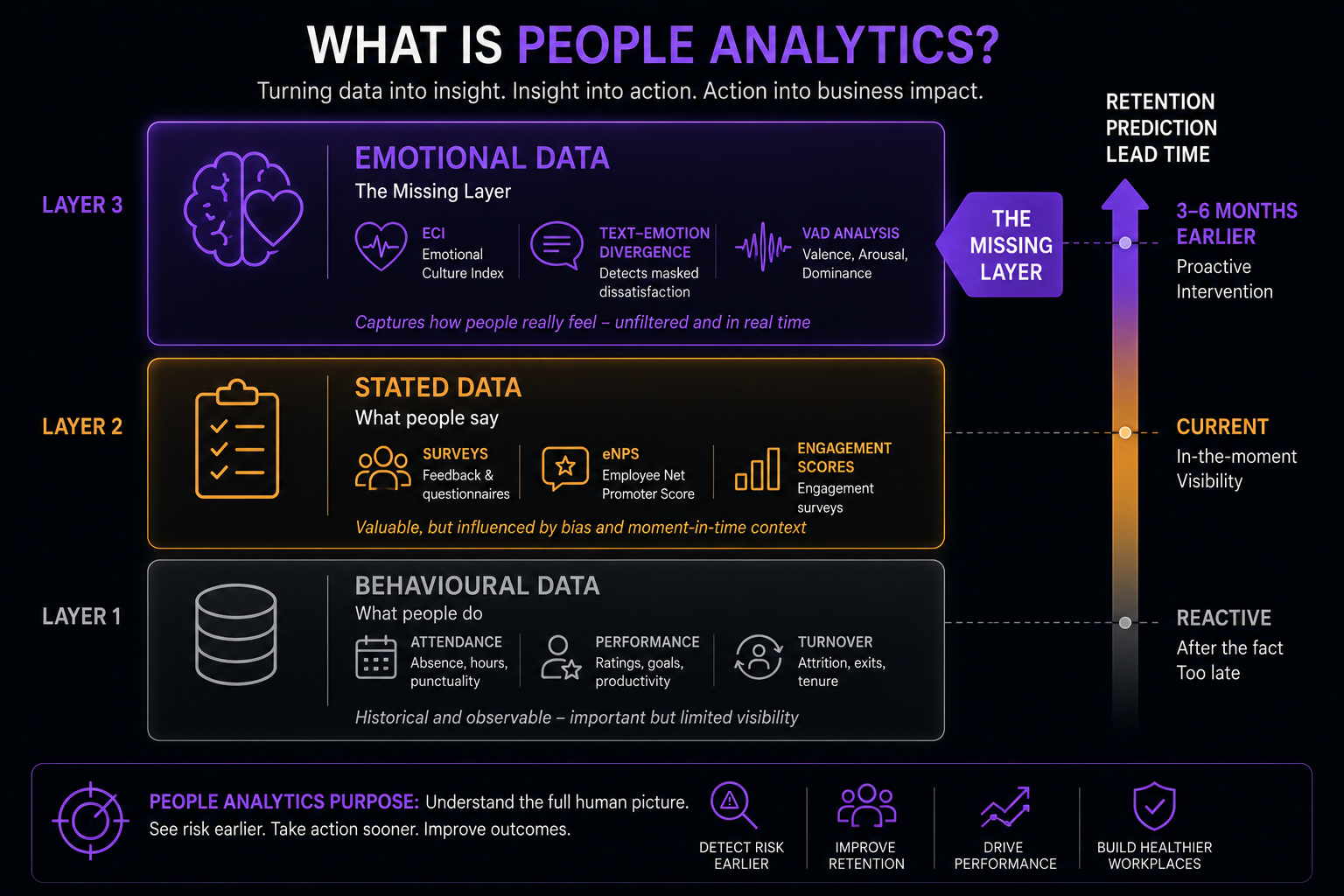
What is people analytics?
People analytics — also called HR analytics, workforce analytics or talent analytics — is the use of data and statistical methods to improve decisions about people in organisations. It encompasses a wide range of data types and analytical approaches:
- Recruitment and selection data: application volumes, interview outcomes, time-to-hire, source quality, offer acceptance rates.
- Performance metrics: objective-setting outcomes, performance review scores, 360-degree feedback patterns, promotion rates.
- Engagement and sentiment: annual engagement surveys, pulse surveys, eNPS scores, open-text qualitative responses. See also: how to measure employee sentiment.
- Retention and turnover: voluntary and involuntary turnover rates, tenure by role and team, exit interview data.
- Learning and development: training completion, skill acquisition, internal mobility, career progression.
- Workforce planning: headcount forecasting, skills gap analysis, succession planning.
The discipline has expanded significantly as HR analytics platforms — Workday, SAP SuccessFactors, Qualtrics, Culture Amp, Glint, Peakon, and other employee experience platforms — have made large-scale data collection and analysis accessible to non-specialist teams. A modern people analytics programme typically spans several of these systems, producing dashboards, trend reports and periodic deep-dives for senior leadership.
What people analytics can and cannot predict
People analytics is very good at describing what has happened. Turnover was 14% in Q3. The engineering team's engagement score dropped 0.6 points. Voluntary exits in sales increased year-on-year. Time-to-hire in product lengthened significantly. These are accurate, useful observations.
People analytics is less reliable at predicting what is about to happen — particularly voluntary turnover, which is the most costly and disruptive outcome most people analytics programmes are designed to prevent. The standard predictors (engagement score decline, absence increase, performance dip) are all lagging signals. By the time they appear in the data, the employee has already made their decision.
The structural reason for this lag is that people analytics measures stated sentiment, not felt sentiment. Employees who have already decided to leave, who are in the pre-exit emotional phase, often continue to perform normally, attend reliably, and write neutrally in surveys. The data shows nothing unusual. The emotional reality — anxiety, disconnection, loss of trust in leadership — is not visible in any metric that people analytics currently captures.
The three layers of people analytics — and the one that's missing
Layer 1 — Behavioural
What employees do
Attendance, performance ratings, promotion velocity, tenure, mobility, absence patterns. Well-captured by HRIS and performance management systems. Lagging signal — behaviour changes after decisions are made.
Layer 2 — Stated sentiment
What employees say they feel
Engagement scores, eNPS, pulse survey responses, open-text comments. Captured by Culture Amp, Qualtrics, Glint, Peakon. Still a lagging signal — socially moderated responses systematically underestimate negative affect.
Layer 3 — Felt sentiment
What employees actually feel
The emotional signal beneath the written response — text-emotion divergence, masked dissatisfaction, the pre-exit emotional pattern. Captured by emotional AI analysis of existing survey data. Leading signal — detectable 3–6 months before resignation.
How emotional AI adds the missing layer
The emotional AI layer does not require new surveys, new participants, or new platforms. It is applied to the open-text data your existing people analytics programme already collects — the comments fields in your Culture Amp, Qualtrics, Glint, or Peakon surveys.
EchoDepth applies VAD (Valence, Arousal, Dominance) emotional analysis to these responses — independently of the words chosen. Where an employee writes positively but the emotional signal is negative, text-emotion divergence is high. Where the negative-to-positive valence ratio in a team's responses exceeds 1.5:1, systemic strain is present. Where a pattern of declining ECI (Employee Culture Index) score is combined with increasing text-emotion divergence, the pre-exit condition is identifiable 3–6 months before it becomes visible in resignations or behaviour changes.
The output is not a replacement for your existing people analytics dashboard. It is an additional layer: a board-ready culture health report identifying which teams, themes, and time periods are showing the largest gap between what employees write and what the emotional signal beneath the text suggests they feel. That gap is exactly what your current people analytics programme cannot see — and what determines which engagement interventions are actually needed.
The people analytics toolkit: what each tool does
| Tool type | What it measures | Structural limitation |
|---|---|---|
| HRIS (Workday, SAP) | Attendance, performance, tenure, mobility | Behavioural lag — signals appear after decisions made |
| Engagement platforms (Culture Amp, Glint, Qualtrics) | Stated sentiment — what employees write in surveys | Social moderation — masked dissatisfaction invisible |
| Exit interview tools | Retrospective stated reasons for leaving | Post-decision rationalisation — not predictive |
| Sentiment analysis (NLP) | Linguistic sentiment of written responses | Word-level only — cannot detect text-emotion divergence |
| Emotional AI (EchoDepth) | Felt sentiment — emotional signal beneath written response | Depth tool, not scale tool — 20–500 respondents |
Common questions about people analytics
Related
Culture analytics & people analytics platform
How EchoDepth adds the emotional AI layer to your existing culture survey and people analytics programme.
Related
Why your culture survey score doesn't predict what's coming
The masked dissatisfaction mechanism — and why engagement scores look stable before resignations occur.
Comparison
EchoDepth vs Culture Amp
How Culture Amp and EchoDepth work together — and what each adds to a people analytics programme.
EchoDepth Insight
Add the emotional AI layer to your people analytics programme.
Send us your most recent culture survey open-text export. We will show you the emotional AI layer — ECI scoring, text-emotion divergence, and the pre-exit pattern — within five working days.